
TL;DR: Blood test timing can affect some measurements, so follow the instructions for the exact test and record the collection time rather than imposing one rule on every panel.
Key takeaways
- Some laboratory measurements vary with time of day.
- The size and practical importance of that variation differ between tests and people.
- Rest, meals, posture, medicines and recent activity can overlap with time effects.
- A morning sample is not automatically required for every blood test.
- Comparable timing can help when a responsible professional recommends repeat testing.
Can blood test timing change results?
Yes, time of day can change some blood measurements, but it does not affect every test in the same way. Biological rhythms, meals, activity, posture and the conditions before collection can all contribute to what the laboratory measures.
A peer-reviewed PLOS One study examined resting time and daytime variation in selected biochemical components. It found time-related changes that could alter classification for some measurements in that study setting.
That is a reason to respect test-specific instructions. It is not evidence that every afternoon sample is wrong, tired or simply not a morning person.
Which blood tests vary by time of day?
Several measurements can show daytime variation, but the effect and clinical relevance depend on the analyte and collection conditions. In the PLOS One study, the researchers assessed albumin, thyroid-stimulating hormone, total calcium and sodium, among other components. The observed patterns were not identical across measurements.

An earlier peer-reviewed Journal of Clinical Pathology study measured 25 biochemical and haematological variables in non-fasting samples from 7,685 British middle-aged men between 9 am and 7 pm. Many measures showed statistically significant daytime variation, but time of day accounted for more than 5 per cent of between-person variation only for bilirubin, phosphate and triglyceride in that study.
Those details matter. Statistical variation is not automatically large enough to change an individual's care, and findings from one population and protocol cannot be copied onto every person or modern test method.
Does every blood test need a morning sample?
No, there is no universal rule that every blood test must be collected in the morning. Some tests have specific timing or fasting instructions, while others may be collected at different times depending on the purpose and service.
Use the instructions from the clinician, laboratory or testing provider responsible for the exact test. If the request specifies a time window, fasting state, medicine timing or rest period, do not substitute generic internet advice.
Morning appointments can be useful for standardising some conditions. They are not a ceremonial requirement bestowed on all blood tubes at sunrise.
Why can rest before collection matter?
Rest can matter because recent posture and activity may affect selected measurements before the sample is analysed. The PLOS One study compared different resting periods and reported changes in several components, showing that collection conditions can overlap with time-of-day effects.
Follow any instruction to sit or rest before collection. If no instruction is given and the question matters for a planned baseline or repeat test, ask the responsible service what it requires.
Do not delay an urgent or clinician-directed test solely to create ideal resting conditions. Clinical need takes priority over making the data set look beautifully symmetrical.
What else can be confused with a timing effect?
Meals, drinks, exercise, posture, sleep, illness, medicines and supplements can all change the context in which a sample is collected. Their relevance varies by test, dose, timing and person.
Record the basics:
- collection date and time;
- whether you followed any fasting instruction;
- recent strenuous or unusual exercise;
- medicines and supplements, without changing them unless advised;
- acute illness or unusual symptoms;
- any difficulty following the provider's preparation instructions.
mescreen™'s live blood biomarker test preparation guide discusses preparation factors and repeatedly directs readers back to the instructions for their actual test. More context can be useful. More context without the correct test instructions is mostly a larger notebook.
Should repeat blood tests happen at the same time?
Using a similar collection time may improve comparability when timing is relevant and the responsible service recommends it. Also try to follow the same test-specific preparation instructions rather than matching the clock while changing everything else.
Comparable conditions do not make two results perfectly interchangeable. Laboratory method, sample quality, normal biological variation, health changes and treatment can still differ.
Do not repeat a test independently just to chase a number at a different hour. Ask the clinician or service responsible for the result whether repeat testing is useful and how it should be prepared.
Can you compare a morning result with an afternoon result?
You can place them side by side, but interpretation may require the collection times, methods, units and reference intervals. Time may be relevant for one analyte and unimportant for another.
Check whether both reports use the same units and laboratory reference interval. mescreen™'s blood test reference range guide explains why an interval is context rather than an individual treatment target.
A difference between two results does not prove that the clock caused it. Association is not attribution, even when the appointment calendar looks suspiciously convenient.
What if the sample was taken at the wrong time?
Do not assume the result is invalid and do not change medicines, supplements, food or exercise in response to timing alone. Tell the responsible clinician or service when the sample was taken and whether you followed the supplied instructions.
They can decide whether timing is relevant to the particular measurement and purpose. The right next step may be no action, interpretation with context or a properly instructed repeat test. An article cannot make that decision for an individual.
If the test was requested because you are acutely unwell or you have urgent symptoms, seek appropriate clinical care. Do not postpone urgent assessment while trying to arrange a tidier collection time.
How should you plan a home blood test?
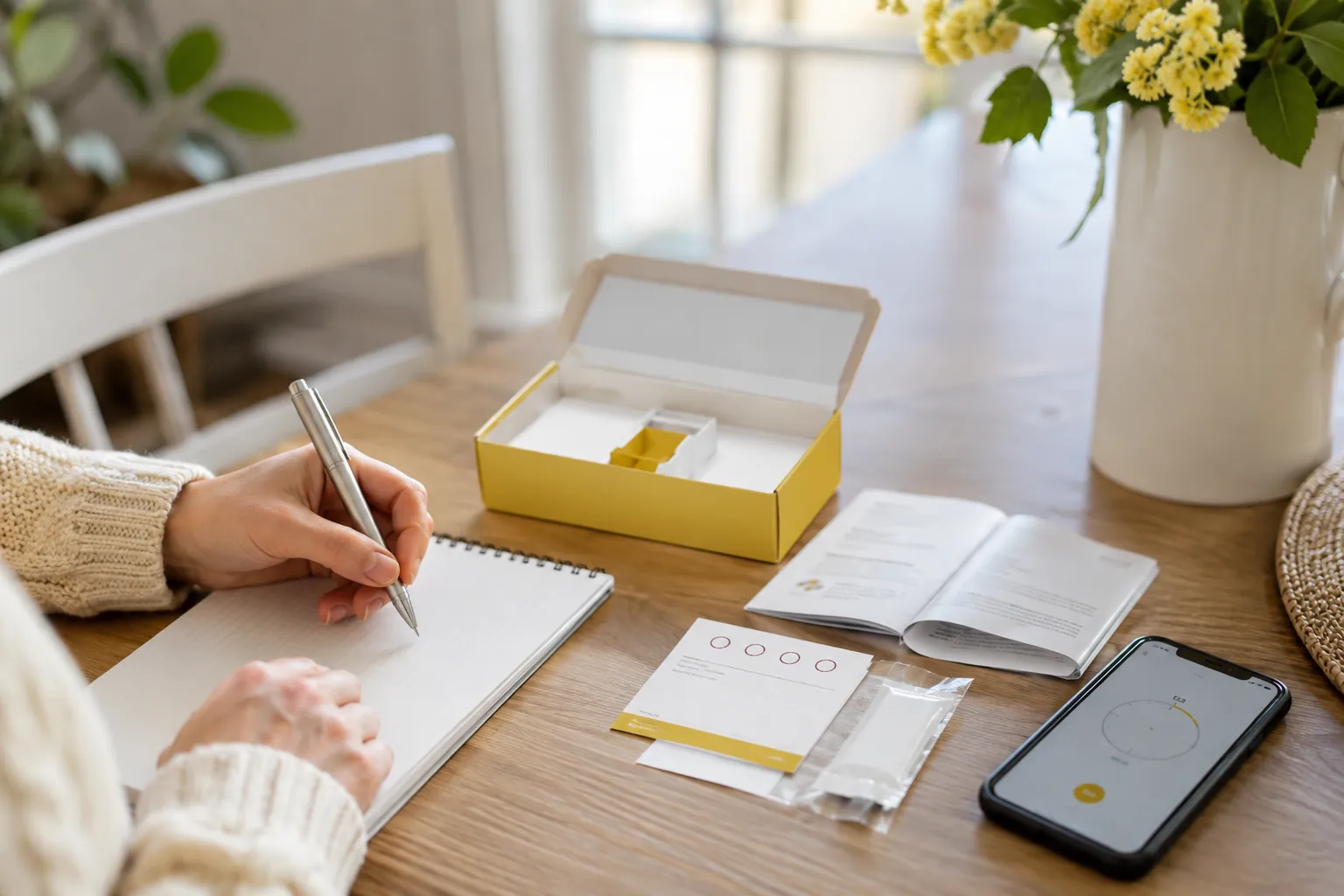
Plan a home test around the instructions supplied with that service, including any stated collection and dispatch requirements. Read the instructions before the chosen collection day, check that the kit is complete and note anything that may affect preparation.
mescreen™'s current How It Works page describes at-home dried blood spot collection, partner-laboratory analysis, digital reporting and an optional educational walkthrough. The page establishes the service process. It does not establish that collection time changes every mescreen™ metric or that one time is universally best.
If an instruction is unclear, contact mescreen™ before changing a normal routine. For clinician-directed investigations, follow the clinician or laboratory instead.
Limitations
This article cannot determine the best collection time for an individual's test or interpret a result. The cited studies used defined populations, analytes, methods, time windows and collection conditions. Their findings cannot be generalised to every modern panel, home test or clinical decision.
The Journal of Clinical Pathology study involved British middle-aged men and non-fasting daytime samples, which limits wider application. The PLOS One study assessed selected biochemical components under a specific protocol. The practical significance of a timing difference depends on the exact test and clinical context.
mescreen™ sources establish its current preparation information and service process only. They do not prove diagnosis, treatment benefit or improved health outcomes from choosing a collection time.
Sources
- Asberg et al., Standardised Resting Time Prior to Blood Sampling and Diurnal Variation, PLOS One
- Pocock et al., Diurnal Variations in Serum Biochemical and Haematological Measurements, Journal of Clinical Pathology
- mescreen™, How to Prepare for a Blood Biomarker Test in the UK
- mescreen™, Blood Test Reference Ranges Explained
- mescreen™, How It Works