
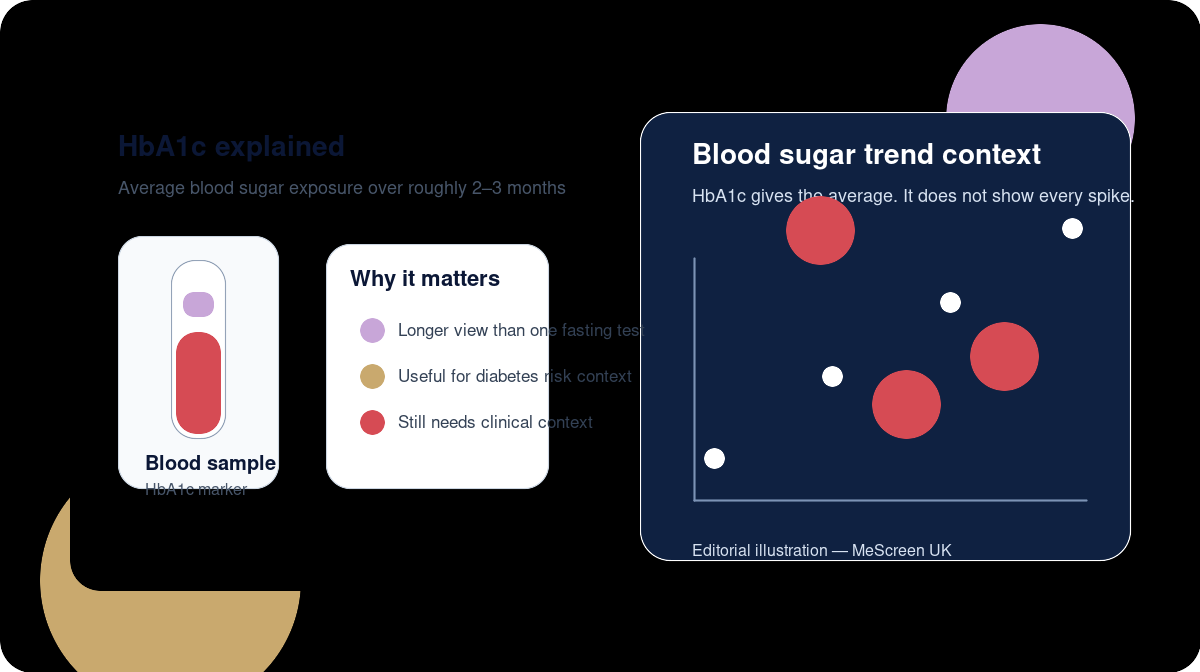
Short answer: HbA1c is a blood marker used to estimate your average blood sugar exposure over roughly the previous two to three months. It is one of the most useful tests in routine metabolic medicine precisely because it smooths out the noise of a single day, but it still needs context and it does not tell the whole story on its own.
For UK readers, that context matters more than the internet usually admits. HbA1c can help flag diabetes risk, show whether a glucose problem has probably been developing for a while and support follow-up decisions with a GP or private clinician. What it cannot do is explain every symptom, capture every blood sugar swing or replace the wider conversation about sleep, body composition, stress, training load and energy resilience.
What HbA1c is actually measuring
HbA1c stands for glycated haemoglobin. In plain English, it reflects how much glucose has attached to haemoglobin inside red blood cells over time. Because red blood cells circulate for weeks rather than hours, the result gives a longer-view average instead of a one-off snapshot.
That longer lens is why clinicians like it. A fasting glucose can be pushed around by a rough night’s sleep, illness, alcohol, stress, travel or a badly-timed breakfast. HbA1c is steadier. It is more useful when the question is, “Has blood sugar probably been running high enough, often enough, to matter?” rather than, “What happened this morning?”
Why HbA1c is useful in practice
The test earns its place because it helps separate temporary noise from a more durable pattern. If someone has gained abdominal weight, feels flatter after meals, has a family history of type 2 diabetes or is recovering badly from stress and training, HbA1c gives a practical way to check whether glucose regulation may be part of that picture.
NICE and NHS pathways use HbA1c because it is convenient, established and clinically meaningful, but good clinicians do not treat it as a personality verdict. They look at the result beside symptoms, fasting glucose, lipid markers, body-composition change and the person’s day-to-day reality. The number matters. The surrounding story matters more.
| Test | What it is good at | What it can miss |
|---|---|---|
| HbA1c | Shows a longer-view average over roughly 2–3 months. | Can underplay short sharp post-meal spikes or early insulin resistance. |
| Fasting glucose | Useful one-morning snapshot of baseline glucose handling. | Moves around more with sleep, stress, illness or recent routine changes. |
| Wider metabolic context | Helps interpret whether energy, weight and recovery patterns fit the blood markers. | Requires a broader conversation, not a single lab result. |
What HbA1c cannot tell you on its own
This is the part most simplified explainers skip. A “normal” HbA1c does not automatically mean metabolic health is perfect. Some people develop post-meal glucose excursions, rising triglycerides, creeping waist size or early insulin resistance before HbA1c clearly shifts. Others have a result that looks borderline but turns out to be heavily shaped by the wider clinical context.
It also does not diagnose the cause of fatigue. If you are tired, under-recovered or mentally foggy, HbA1c might be part of the puzzle, but it is rarely the whole picture. Sleep debt, stress load, alcohol intake, inactivity, nutritional pattern and mitochondrial resilience all shape how someone feels day to day. That is why neat numbers can coexist with a very untidy lived experience.
Why HbA1c belongs in a wider metabolic conversation
HbA1c becomes far more useful when paired with the rest of the pattern. A result means more if it sits next to rising fasting glucose, an unfavourable triglyceride-HDL ratio, poor recovery, central weight gain or a history of irregular meals and broken sleep. On the other hand, a slightly concerning result may look different after a clinician reviews recent illness, medicines or repeat testing.
That wider framing matters for the mescreen™ audience because metabolic strain and energy strain often travel together. If glucose regulation is becoming less efficient, the person may notice it not just in a blood test but in appetite swings, flatter afternoon energy, poorer resilience to training or slower recovery.
Where HbA1c connects to energy and recovery
HbA1c does not measure mitochondrial function directly. What it can do is signal whether part of the metabolic environment around the mitochondria may be getting less favourable. Repeated glucose dysregulation, poor sleep and visceral-fat gain do not stay in one tidy box labelled “blood sugar”. They affect recovery, inflammation, appetite, training tolerance and how stable energy feels across the week.
That is why some people become interested in mitochondrial testing only after a broader metabolic marker starts moving. A borderline or rising HbA1c can be the first objective nudge that the body is handling everyday stress less efficiently than before. It does not prove a mitochondrial problem, but it can justify a more serious look at the full recovery picture rather than another round of vague reassurance.
Research context: A 2023 Antioxidants and Redox Signaling review discusses mitochondrial dysfunction and mitophagy in type 2 diabetes biology. That supports the wider metabolic frame, not a diagnosis. HbA1c is still a glucose marker, and mescreen™ does not diagnose diabetes or replace the right clinical route.
Practical questions UK patients should ask
If your HbA1c result concerns you, start with practical questions instead of catastrophising. Has your weight changed in the past year? Are you sleeping badly? Have meals become more erratic? Are you drinking more than you think? Do you feel markedly worse after high-carbohydrate meals? Is there a strong family history of type 2 diabetes? Does the HbA1c line up with your fasting glucose and the rest of your blood work, or does it need repeating?
This is also where the UK context matters. Many people live in the grey zone between “not ill enough to chase urgently” and “not feeling properly well either”. HbA1c is useful because it gives that grey zone more structure. A result does not make the decision for you, but it helps decide whether “leave it and hope” is sensible or whether the pattern deserves proper follow-up.
Where mescreen™ fits
mescreen™ is not a diabetes diagnostic service and it should never replace the right NHS or private medical route when HbA1c is raised or symptoms are concerning. Its role is different. It helps people look at the cellular-energy side of the conversation: whether persistent fatigue, poor recovery or low resilience deserve a more organised explanation than “you are probably just busy”.
If the standard glucose conversation is already underway, mitochondrial wellness data can add another layer. It can help people think about why two individuals with similar lifestyles do not always experience stress, exercise load or recovery in the same way. That does not downgrade the value of HbA1c. It sharpens the next question.
Practical next steps
If your HbA1c is higher than expected, the sensible next move is usually to confirm the wider picture rather than lurch into internet self-diagnosis. Review sleep, alcohol, weight pattern, meal rhythm and activity; compare the result with fasting glucose and related markers; and discuss repeat or follow-up testing if the number does not fit your lived reality.
Once the obvious glucose and diabetes questions are being handled properly, it can be worth asking a second question: is the issue only blood sugar, or is there a broader pattern of low resilience and cellular-energy strain? If that second question sounds familiar, explore the mescreen™ mitochondrial function test, our biomarker testing guidance and our explainer on what cellular health tests actually measure.
Sources checked for readers: NHS type 2 diabetes overview, NICE guideline NG28, NCBI HbA1c overview, and CDC A1C overview.
FAQ
Is HbA1c the same as a fasting glucose test?
No. HbA1c estimates average blood sugar exposure over roughly the previous two to three months, while fasting glucose is a single-time-point reading taken after an overnight fast.
Can HbA1c miss early blood sugar problems?
It can. HbA1c is useful, but some people develop post-meal glucose spikes or early insulin resistance before their HbA1c clearly moves out of range.
Does one bad weekend push HbA1c up straight away?
Usually no. HbA1c reflects a longer average, so one weekend does not define the result. Repeated weeks of poor sleep, high-calorie intake or inactivity matter more.
Should I repeat HbA1c if the result surprises me?
Often yes. If the number does not fit your wider picture, a clinician may repeat it or compare it with fasting glucose and other markers before drawing conclusions.
Can mescreen™ diagnose diabetes or prediabetes?
No. mescreen™ is a mitochondrial wellness tool, not a diabetes diagnostic service. Concerns about diabetes or prediabetes still need the appropriate NHS or private clinical route.